
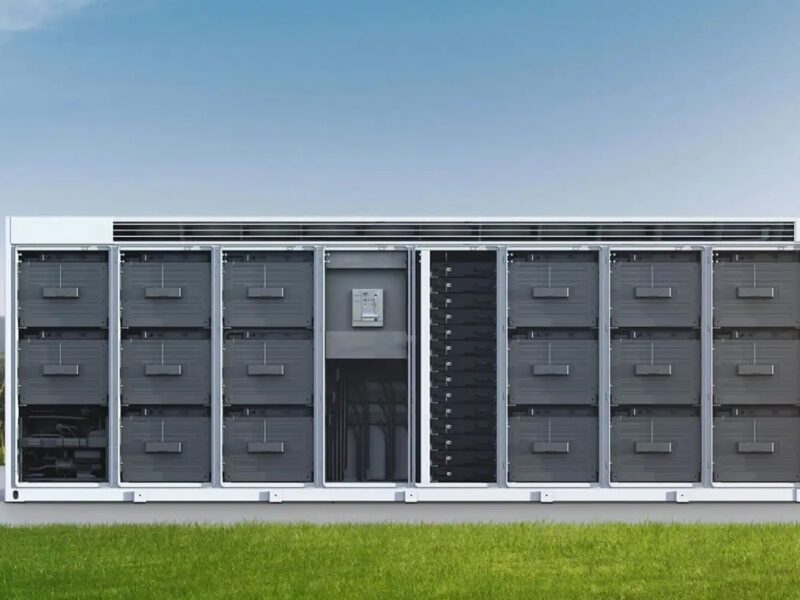
Last fall, a C&I energy storage customer came to us with an urgent problem. After roughly two years in the field, a batch of their outdoor battery Cabinets was showing door panel corrosion and seal degradation, with water finding its way inside. The cells and BMS were fine. The problem was in the one place nobody had been looking: the enclosure itself.
After years of fabricating sheet metal and CNC components, we’ve seen this story more than once at FEITO. The U.S. storage market has grown at a breakneck pace, and rightfully, most engineering attention goes to cells and system efficiency. The enclosure — the equipment’s skeleton — usually only gets attention after something goes wrong.
This article is about the battery Cabinets details that tend to get underestimated, from the perspective of the people who fabricate them.
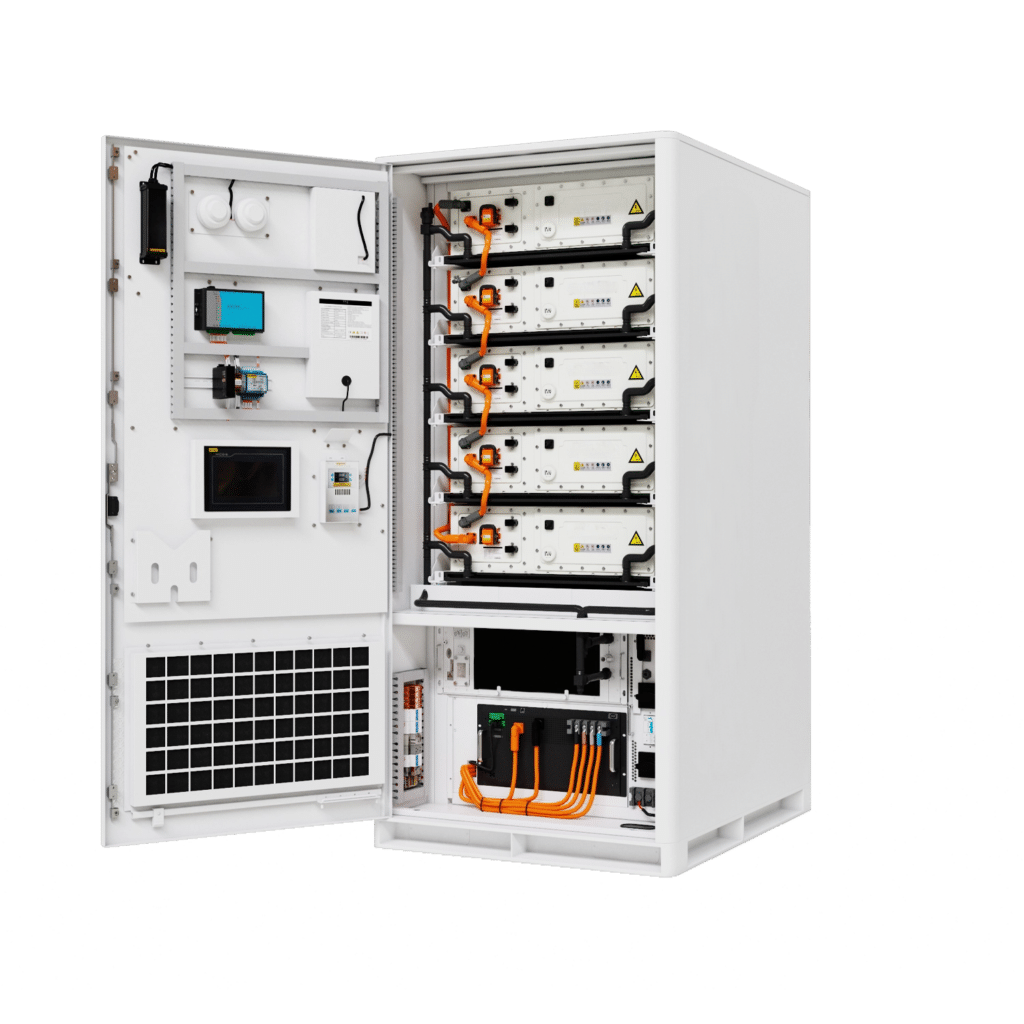
A typical C&I energy storage cabinet. The structure looks simple; the difficulty is in the details.
Part 1: Where the Real Difficulty Lies in a Storage Cabinet’s Metal Components
From the outside, a storage cabinet is “a metal box.” From the inside, there are at least four technical challenges — and each one fails silently.
1. Enclosure and door: NEMA ratings are built through fit-up, not printed on the drawing
Many drawings specify NEMA 3R or NEMA 4, but few people ask the follow-up question: is that rating achieved by design, or by manufacturing fit-up?
Sealing performance is the result of an entire dimensional chain — door flatness, gasket compression, hinge mounting accuracy. Take gasket compression: the rule of thumb is 30–50%. Under-compress and water migrates in; over-compress and the gasket takes a permanent set within two to three years. In the case above, the doors had flatness deviations after bending, leaving portions of the gasket in chronic over-compression.
At FEITO, our habit on prototypes is to hold sealing surfaces to a controlled finishing operation rather than relying on “natural” bending accuracy. It adds a few percentage points of cost — but the first-pass rate on ingress testing is a completely different story.
2. Internal trays and racking: can your structure handle cell swelling?
LFP cells exert continuous expansion force through every charge-discharge cycle. A battery pack’s tray and mounting brackets have to live with that invisible force for ten-plus years.
One detail that’s easy to miss: how to allocate tolerances between sheet metal parts and CNC-machined parts. A formed sheet metal bracket realistically holds ±0.008 in or worse; a machined locating feature holds ±0.002 in. If the drawing doesn’t define the mating relationship clearly, assembly ends up with “some places you have to hammer in, some places rattling loose.”
3. Busbars and shunts: contact surface flatness is where heating begins
On high-current paths, contact surface flatness directly determines contact resistance. A seemingly minor flatness deviation becomes continuous local heating at hundreds of amperes — and heat is the starting point of nearly every electrical failure.
The craft of busbar fabrication lies in springback compensation after bending, the contact surface finish (tin plating vs. silver plating, and how thoroughly the pretreatment was done), and accumulated tolerance across mounting holes. On the drawing, this is often a single line of technical requirements. Delivering on it takes process control, not luck.
4. Thermal management and vents: airflow and structural strength are natural enemies
Better airflow means more openings; more openings mean less strength. Add stiffening ribs and you disturb the airflow. There is no standard answer — only a structural trade-off against the specific results of your thermal simulation. Bend direction, rib placement, hole pattern: every decision has to give and take with the thermal design.
And remember: a cabinet validated in a mild climate behaves very differently in a Texas summer (120°F+ inside surface temperatures are common) or a Florida hurricane zone (driven rain plus salt-laden air).
Part 2: Two Field Problem-Solving Stories
Specific problems teach more than a hundred claims of “we’re reliable.”
Case 1: Condensation inside an outdoor cabinet — it wasn’t all “bad sealing”
A customer’s outdoor cabinets in the Southeast were developing internal condensation, with BMS reporting insulation faults. First suspicion, naturally, was seal failure. But ingress testing passed across the board.
FEITO’s engineering team reproduced the issue on site. The enclosure sealed fine — the problem was thermal. The cabinet’s steel skin conducted heat too efficiently; on humid nights, interior air reached dew point along the ceiling and sidewall panels, and condensation tracked along stiffening ribs into the electrical compartment. The fix was structural, not cosmetic: rerouting internal airflow so conditioned air never impinged directly on cold surfaces, plus a thermal barrier coating on the interior. No redesign of the system — and the problem was gone.
This is how we handle such problems at FEITO: reproduce first, dissect second, fix the process third — not simply rework and reship.
Case 2: Plating peeling off a busbar — the culprit was the pretreatment you never see
Another case: a customer’s tin-plated busbars began flaking within months, contact resistance climbing. On the surface it looked like a plating problem. Digging deeper, we found micro-cracks from bending had trapped acid residue during pretreatment cleaning — the plating had lifted starting from those micro-cracks.
The fix wasn’t complicated: an improved cleaning cycle and post-bend surface treatment. But if you only stare at the plating operation, this root cause can stay hidden forever.
Outdoor storage cabinets: water, corrosion, and heat — a combined test of structure and process.
Part 3: An Observation the Industry May Not Want to Hear
Bid prices for storage enclosures have been sliding year over year. Here’s a view that may be uncomfortable: the enclosure is precisely the part of a storage system that “can’t be seen in the short term and can’t be skipped in the long term.”
Cell efficiency and cycle life have clear, measurable specs. But whether a door still seals at year five, whether trays have deformed, whether busbars are running hot — nobody asks at bid time, and at failure time, it’s entirely the equipment maker’s problem.
There’s another characteristic of enclosure quality issues: they’re nearly impossible to catch at final inspection. Passing an ingress test and a dimensional full inspection means nothing about gasket aging at year two or stress corrosion at a weld. This is also why FEITO keeps sheet metal fabrication and CNC machining under one roof — structural problems tend to occur at the junctions: where a formed part meets a machined part, where welding hands off to finishing. The more fragmented the process chain, the harder it becomes to say which operation owns the problem.
For U.S. projects, there’s a compliance dimension too. As AHJs (Authorities Having Jurisdiction) apply NEC requirements for energy storage systems and UL 9540/9540A listings, the enclosure increasingly isn’t just a box — it’s part of the listed system. A supplier who understands what a UL 508A panel shop needs from the sheet metal behind it saves real time in certification.
Closing
Storage systems are designed for a ten-plus-year life. Over that decade, cells can be swapped and systems upgraded — but the enclosure, the trays, and the busbars don’t get a second chance.
If your storage project is running into structural challenges — a drawing you’re not sure how to refine, a field problem whose root cause won’t reveal itself, or even if you’d just like to talk it through with someone who’s seen a few of these — FEITO’s engineering team is happy to sit down with you.